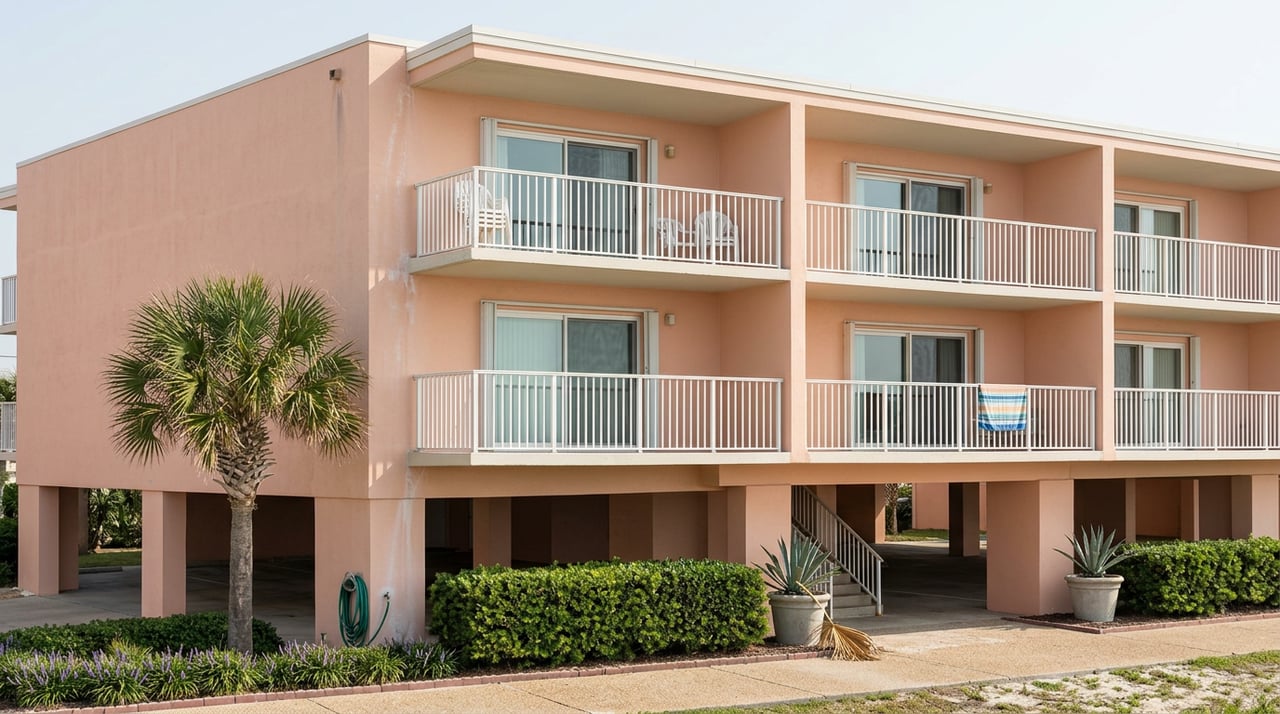
Why North Myrtle Beach's Oldest Oceanfront Condos Are Exempt From the Rules Meant to Protect Buyers
August 27, 2026
August 27, 2026
A buyer we spoke with this summer had already picked her building. A top-floor unit in the Windy Hill section, ocean view, close enough to the Cherry Grove Fishing Pier that she could walk to it before dinner. She had read that federal lenders tightened condo rules in 2026 and figured that meant her financing would come with a safety check built in, someone making sure the building itself was sound before her loan closed.
It doesn't work that way for a meaningful share of North Myrtle Beach's classic oceanfront towers, and that gap is worth understanding before you write an offer.
Fannie Mae published Lender Letter LL-2026-03 on March 18, 2026. The guidance moves most established condo projects into a full review process, and for loan applications submitted on or after January 4, 2027, associations without a compliant reserve study should expect to need reserve funding equal to 15 percent of the annual budget. Freddie Mac issued separate but parallel guidance around the same time. Lenders and board packets often talk about it as one combined policy, but it isn't. Two agencies, two sets of requirements, and it's worth asking your lender which one actually applies to the building you're looking at.
The intent behind all of this traces back to the 2021 partial collapse of Champlain Towers South in Surfside, Florida. In the years since, Fannie Mae and Freddie Mac have both pushed condo associations toward stronger reserve funding and more documented inspection history, treating financing eligibility as the lever since state law in most places, including South Carolina, doesn't require it directly.
That's the part buyers miss. The federal review only reaches buildings that go through federal review in the first place.
Many resort-style condos along the Grand Strand, North Myrtle Beach included, are classified by conventional lenders as non-warrantable. That status has nothing to do with age or condition on its own. It usually comes down to how the building operates: a high share of units in a nightly rental program, a single entity or management company controlling too many units, or an owner-occupancy ratio that falls below what Fannie Mae and Freddie Mac want to see. Buildings built around vacation rental income, which describes a lot of oceanfront inventory in Cherry Grove, Windy Hill, and Crescent Beach, often carry exactly these characteristics.
If a building is non-warrantable, Fannie Mae and Freddie Mac loans simply aren't an option. Buyers turn to portfolio lenders instead, typically putting down 20 to 30 percent and accepting a somewhat higher rate. That's a real cost, but it's a known one. The less obvious consequence is that a non-warrantable building never enters the federal review pipeline at all. The new reserve-funding thresholds, the critical-repair screening, the whole architecture built after Surfside, none of it applies, because the loans backing those units were never going through Fannie Mae or Freddie Mac to begin with.
Here's a simple way to see the split:
| Warrantable building | Non-warrantable building | |
|---|---|---|
| Financing | Conventional loans through Fannie Mae or Freddie Mac | Portfolio or specialty condo lenders only |
| Typical down payment | Standard conventional terms | Commonly 20 to 30 percent |
| Subject to 2026 federal reserve review | Yes, under LL-2026-03 and parallel Freddie Mac guidance | No, the building falls outside that pipeline entirely |
| Who checks building soundness | Lender-required reserve study and inspection review | Whatever the buyer chooses to request |
Some buildings do move between categories as ownership patterns shift. If a resort tower's owner-occupancy climbs over time, or a rental program winds down, a building that was non-warrantable a few years ago can become warrantable. That status isn't fixed. It's worth confirming current status building by building rather than assuming last year's answer still holds.
Florida responded to Surfside with new laws requiring milestone structural inspections and mandatory reserve funding for condo buildings three stories and taller. South Carolina hasn't followed. As of mid-2026, the state has no statutory requirement for condo or HOA associations to conduct a reserve study, and no structural inspection mandate tied to building age or height. A pending state bill tied to insurance renewal, H.5063, has been introduced but remains a proposal, not law.
That leaves South Carolina condo owners in an unusual position. The board's decision to commission a reserve study is entirely voluntary unless the association's own governing documents require one. Many older declarations don't. So the only outside pressure pushing a board toward disciplined reserve planning is the lender review that comes with financed sales, and as we've covered, that pressure doesn't reach non-warrantable buildings at all.
There is a bill moving through the South Carolina legislature that would change part of this. Bill 5204, introduced in the House on February 18, 2026, would require newly formed homeowners associations to complete reserve studies every three years and reach full reserve funding, and would give existing associations until January 1, 2037 to reach full funding. It would also create something called an HOA Seller Packet, a standardized disclosure buyers could request before closing that would include the association's reserve study, current reserve balance, percentage of units rented versus owner-occupied, and any known upcoming assessments. The bill is still in committee as of this writing. It has not passed, and nothing about it applies to a purchase closing this year.
North Myrtle Beach's oceanfront inventory spans a wide range of ages and structures, which is part of why a blanket rule doesn't serve buyers well here. Cherry Grove Villas, a second-row luxury condo complex near the Cherry Grove Fishing Pier, was built in 2007 and operates with a mix of owner use and rental. Ocean Pier IV in Windy Hill is a boutique building with only 36 units, small enough that a handful of non-owner-occupied units can swing the ratio that determines warrantability. Larger towers along Ocean Drive and Crescent Beach carry different rental program structures entirely, some leaning heavily into nightly rental management that puts them squarely in non-warrantable territory regardless of reserve health.
None of this means a non-warrantable building is a bad building. It means the paperwork a buyer needs to gather is different, and the person gathering it is you, not a federal underwriter.
Whether a building turns out to be warrantable or not, the documents worth requesting are the same:
If the building is warrantable, your lender will request most of these anyway as part of the federal review. If it's non-warrantable, nobody is going to ask for them on your behalf, which is exactly why it matters that you do.
Does non-warrantable mean the building is unsafe? No. Warrantability is a financing classification tied mostly to rental program structure and ownership concentration, not structural condition. A building can be perfectly sound and still fall outside conventional lending because of how many units are in a nightly rental pool.
Can I use an FHA loan instead? FHA has its own condo approval list and its own occupancy and reserve requirements, separate from Fannie Mae and Freddie Mac. A building ineligible for conventional financing may or may not carry FHA approval, so it's worth checking both independently rather than assuming one implies the other.
Is cash the only way around this? Cash sidesteps financing eligibility questions entirely, and it's part of why cash purchases have become more common in Grand Strand oceanfront condos in recent years. It doesn't remove the need for due diligence on reserves, insurance, and association health. Those questions matter just as much whether you're financing or paying outright.
If you're weighing a specific building in Cherry Grove, Windy Hill, Crescent Beach, or Ocean Drive, we can pull its warrantability status and HOA financials before you write anything. Start with our North Myrtle Beach neighborhood guide or our buyer's guide for the broader process, and when you're ready to talk specifics, Carrie Gerald is a call away.
Stay up to date on the latest real estate trends.

Make your next move with the confidence of decades of local insight. We focus on clear communication and reliable representation from start to finish.